License plates are the metal tags that tie a vehicle to the state that registered it. In New Jersey, that tag shows “New Jersey” across the top and “Garden State” along the bottom, with black characters over a yellow-to-white fade. Most passenger cars carry two tags, one on the front and one on the rear. The New Jersey Motor Vehicle Commission, known as the MVC, issues every one of them.
License plates in New Jersey come in several classes, from standard passenger tags to commercial, trailer, motorcycle, historic, dedicated, and temporary versions. Each class follows its own serial pattern and its own price. Drivers often need a fresh set after moving, buying, or losing a tag, and the steps differ for every case. This page covers the types, the costs, the display rules, and the exact process for each situation.
How to Get a New Jersey License Plate
License plates are issued as part of the vehicle registration process. A buyer who moves into the state, buys a car, or registers a vehicle for the first time handles titling and registration together. The MVC asks for a valid title or title application, proof of insurance, inspection papers when needed, and payment of the taxes and fees tied to the class. Once the record is complete, the new tag is handed over at the counter or mailed to the address on file.
Standard Plates for a New Registration
A buyer can finish a new registration at the dealer or at an agency. A dealer that takes part in the online program files the title and registration and hands over the plates on site. A private sale sends the buyer to a Vehicle Center with the signed title and proof of coverage. Either way, bring the title, a driver’s license, and an insurance card, and pay the registration fee, which covers the plates. A car that has never held a title takes a four-year term, and a lease runs for the length of the contract. Private sales take longer than a dealer visit, and the buyer and the seller usually meet at an agency to sign the title in front of staff. A bill of sale helps prove the price paid and the date of the handover, and some buyers bring a notary to settle the paperwork before the trip.
- New Jersey License Plate Registration:
- https://www.nj.gov/mvc/vehicles/reginitial.htm
Documents You Need at the Counter
The MVC checks six points of identity and confirms valid coverage before any plate is released. A missing document sends the visit back to the start, so call the agency ahead of time if the title sits with a lender or carries an out-of-state seal.
- Driver’s license or a non-driver ID card
- Proof of insurance with the policy number
- The signed Certificate of Title or the dealer packet
- Application for Vehicle Registration, Form BA-49
- Payment by card, check, or money order
Moving From Another State
Out-of-state owners surrender the old plates or mail them back to the state that issued them, then complete the title transfer and pay the state sales tax. A trip to a Vehicle Center with the old title, the out-of-state registration, and proof of address closes the process, and the owner leaves with a fresh set of Garden State plates. New residents get a short window to make the switch, and driving on expired out-of-state plates after that window can lead to a citation. The MVC will not accept another state’s tag for surrender, so those plates travel back to the state that printed them.
License Plate Requirements
A plate only counts as valid when the vehicle, the owner, and the coverage all line up. The MVC checks each part before it releases a tag, and a single gap in the record stalls the whole request. A buyer who gathers the papers first saves a second trip to the counter. The parts below cover the vehicle, the policy, and the inspection step.
Vehicle and Owner Rules
The vehicle must carry a state title in the owner’s name, and the owner must hold a valid driver’s license or a state ID. The registration must match the vehicle’s class and weight. A leased car runs under the leasing company’s name with the driver listed as the operator. A rebuilt or salvaged vehicle follows a longer path. The owner brings the salvage paperwork, passes an inspection, and then applies for a title before any tag is issued.
Insurance Coverage
New Jersey ties plates to insurance. A policy must stay active the entire time the tag is on the road. If coverage ends, the plates must come off the car and go back to the MVC within five days. A lapse can trigger a registration suspension and a daily penalty that adds up fast.
Inspection Notes
Most cars need regular safety and emissions checks. Historic and collector vehicles sit outside that rule. A collector vehicle decal lasts five years, and the current charge appears in the fee table below.
New Jersey License Plate Types
The MVC offers a wide catalog of plate classes, and each one serves a different owner. Private drivers take the standard tag. Businesses use commercial and trailer tags. Collectors pick historic and street rod plates. Good causes offer dedicated designs, and dealers hand out temporary tags.
| Plate Type | Who It Is For | Serial Pattern |
|---|---|---|
| Standard passenger | Private cars and SUVs | A12-BCD |
| Commercial | Business vehicles | XBC-D12 |
| Trailer | Towed units | A12-TCD |
| Omnibus | Buses | OBC1234 |
| Motorcycle | Bikes and mopeds | 1ABC2 |
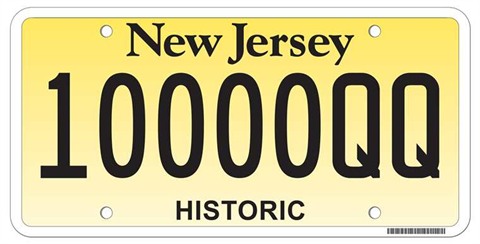
| Historic | Cars 25 years or older | 12345QQ |
| Street rod | Modified antiques | R1234 |
| Dedicated | Cause and group members | Varies |
| Temporary | Sales in progress | A123456 |
Standard Passenger Plates
The standard tag is the one most drivers see. It uses black lettering on a yellow-to-white fade and carries the words “Garden State” at the bottom edge. Two plates arrive for a car, and one plate arrives for a trailer or a motorcycle. A new tag uses flat screened characters instead of raised ones, a change that started in April 2014.
Personalized and Vanity Plates
A personalized tag lets the owner choose their own letters and numbers. The MVC accepts up to seven characters, with at least three letters. A second charge follows if the registration lapses for more than two years. Orders run through a MyMVC account or Form SP-1 at the Special Plate Unit in Trenton. The fee table below lists the current rate.
Dedicated and Specialty Plates
Dedicated tags raise money for a cause. Animal Friendly, Meadowlands, Pinelands, Shore to Please, Treasure Our Trees, and Liberty State Park are a few of them. Most designs carry a starting charge and a yearly renewal, and a couple follow their own schedule. The USS New Jersey Battleship and Agriculture are the two exceptions. Current rates sit in the fee table below.
Historic and Street Rod Plates
Historic tags serve vehicles that are at least 25 years old and used for shows or teaching. The serial ends in QQ. A modified antique built before 1949 can take a Street Rod plate instead. Historic registration renews every three years, and the renewal carries no charge.
Commercial, Trailer, and Omnibus Plates
Business plates carry an X prefix. Trailers use a T series, buses use an O series, and dealer stock uses a D series. Each class must match the vehicle’s weight and use, and a fleet owner may register many units under one account. Weight limits and cargo rules decide which class fits a given truck.
Motorcycle and Moped Plates
Motorcycles, mopeds, and autocycles receive a single rear tag. Sizes are smaller than a car plate, and mounting holes sit at the top of the tag. A motorcycle tag can be personalized, but a motorcycle historic tag cannot.
Temporary Plates and Temp Tags
A temporary tag covers the gap between a sale and a full registration. The state moved temp tags to a digital print system in 2024. The new tags use light grey security paper with a holographic MVC logo, and each dealer may print one tag per sale.
Which Plate Fits Your Vehicle?
A daily driver, SUV, or pickup under 8,500 pounds takes a standard passenger tag. A box truck, van, or work rig needs a commercial plate, and a boat trailer, utility trailer, or camper uses a trailer tag. A bus or shuttle carries an omnibus plate, and a bike, scooter, or moped uses a motorcycle tag. A car built before 2001 in show condition qualifies for a historic plate, and a modified pre-1949 build takes a street rod plate. A cause, college, or club member can order a dedicated design. Plate size stays the same across the classes, so a frame, a cover, or a bracket fits any of them. Only the motorcycle tag breaks that pattern with a shorter body and a two-hole mount at the top.
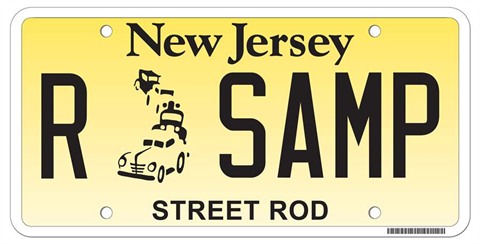
Plate Format and Numbering
The serial on a tag follows a fixed pattern that changes only when a series runs out. The current layout uses three digits, a hyphen, and three letters. Older tags use different layouts, and all of them stay legal as long as the registration never lapses.
The Current A12-BCD Format
Passenger plates moved to the A12-BCD layout in July 2010. The first character is a letter, then two digits, a hyphen, and three more letters. The letter at the front advances before the trailing letters change.
Older Formats Still on the Road
The ABC1234 layout ran from late 1992 through 2010. Before that, the blue base used a 123-ABC pattern from 1979 to 1992, and the buff base used an ABC-123 pattern from 1959 to 1979. All passenger plates from 1959 onward remain legal as long as the registration never lapsed.
Letters That Never Appear
Three letters are left out of every serial. The MVC skips I, O, and Q so they cannot be confused with the numbers 1 and 0. This rule has held since 1959.
New Jersey License Plate Fees
Plate prices depend on the class and on whether the order is a first issue, a renewal, or a replacement. A standard replacement is cheap. Specialty and personalized tags cost more. The list below reflects the current MVC schedule.
| Plate Item | Fee |
|---|---|
| Standard replacement plate | $6 |
| Dedicated or special interest replacement | $11 |
| Personalized plate (one-time) | $50 |
| Dedicated plate initial | $50 |
| Dedicated plate annual renewal | $10 |
| USS New Jersey Battleship renewal | $15 |
| Agriculture plate initial | $20 |
| Historic plate | $44 |
| Courtesy historic plate | $74 |
| Personalized historic plate | $94 |
| Street rod plate | $15 |
| Temporary non-resident registration | $5 |
| Collector vehicle decal (per issue) | $25 |
| Registration renewal | Varies by weight and class |
Replacement and Duplicate Plates
A lost, stolen, or damaged tag can be remade with the same characters or swapped for a new serial. Remakes use Form SPU-89. A remake keeps the original serial, and a replacement issues the next available number. A stolen tag goes on a police report first, and the agency then wants the registration and a photo ID. Settle the replacement amount printed in the table above, and bring the old tag if it is still in hand. Prices change when the MVC updates its schedule, so check the current chart before a visit. A dealer that files the paperwork may add its own service charge on top of the state fee, and the payment receipt belongs in the glove box along with the registration card.
Front vs Rear Plate Rules
Two tags go on most vehicles, but the rules split between the front and the rear position. The front tag shows the plate face to oncoming traffic. The rear tag faces toll readers and carries the night-time lighting duty.
| Rule | Front Plate | Rear Plate |
|---|---|---|
| Required on passenger cars | Yes | Yes |
| Required on motorcycles and trailers | No | Yes |
| Must be lamp-lit at night | No | Yes, visible from 50 feet |
| Must sit 12 to 48 inches off the ground | Yes | Yes |
| Must stay free of grease and blur | Yes | Yes |
Plate Frames and Covers
A frame or cover cannot hide any lettering on the tag. The state name, the serial, and the renewal marks must stay readable. A first offense carries a fine of up to $100, and a repeat offense can double that amount. A state Supreme Court ruling held that a driver breaks the law when a frame blocks a marking that a person cannot clearly read.
Damaged and Faded Tags
A tag that has faded, peeled, or rusted must be replaced. Characters have to stay clear at all times, day or night. An MVC agent can flag a worn tag during a transfer visit, and the only swap offered at that point is a current yellow design.
Where to Mount Plates on a Vehicle
Mounting position matters as much as the tag itself. A plate hung in the wrong spot can draw a ticket even when the registration is perfect. The law sets a height range, a level angle, and a lighting duty for the rear tag. A driver who checks the mount once a year avoids the most common defects and the fine that follows.
Legal Placement
State law sets a height range for every tag. Keep the plate between 12 and 48 inches from the ground and keep it level, not tilted or flipped. Attach the plate so it does not swing, and use both top holes and both bottom holes when offered. Skip the dashboard and the windshield, since the front tag must sit on the bumper. A tank truck, a trailer hauling flammable liquid, or a sanitation vehicle may mount the rear tag higher than 48 inches.
Lighting and Visibility
The rear tag needs a working lamp at night. Light must reach the plate so a reader can see it from 50 feet away under normal sky conditions. A burned-out bulb counts as a defect and can lead to a stop.
Mounting Mistakes That Draw a Stop
A cover that tints or dims the characters can lead to a stop, and a frame that hides “Garden State” or the serial breaks the display rule. A plate hung upside down or at an angle draws attention for the wrong reason. One loose bolt lets the tag rattle, and a tinted shell over a renewal sticker hides a marking that must stay visible.
How to Replace a Lost or Damaged Plate
A missing or worn tag needs a fresh one before the vehicle goes back on the road. Two paths exist, and the right one depends on whether the owner wants the same characters or a brand new serial.
Ordering a Remake
A remake keeps the original serial, and the MVC uses Form SPU-89 for this job. It works only when the old design can still be produced, so a blue tag from the 1980s cannot be reprinted and the remake lands on the current yellow style.
- Fill out Form SPU-89 with the current serial
- Bring the registration and a photo ID to an agency
- Pay the remake charge listed in the fee table
- Wait for the new tag to arrive by mail, then mount it
Ordering a Replacement
A replacement issues the next open serial in the series rather than the characters on the old tag. The MVC sets the amount by the design that came off the car, so a specialty plate runs higher than a standard pair. A driver files the request at a Vehicle Center or by mail, and the state mails the fresh set once the record clears.
- Report a stolen tag to the local police first
- Visit a Vehicle Center with the registration and photo ID
- Pay the replacement charge from the fee table
- Hand over the old plates if they are still in hand
- Update any parking pass or toll account tied to the old number
Reporting a Stolen Plate
A stolen tag can ring up toll charges in another county within hours. File a police report the same day, keep the report number, and ask the MVC to flag the serial. The report protects a driver if a camera catches the missing tag on a road they never drove.
How to Return or Surrender Plates
Plates must go back to the state when a vehicle leaves the road or changes hands without a transfer. Surrender protects the owner from tickets and toll bills tied to the old serial. The MVC offers two ways to hand plates back.
Drop Box or Agency Counter
Visit any MVC Vehicle Center during open hours and hand the plates to staff, or drop them in the box outside the building. Ask for a receipt at the greeter desk if a suspension must be cleared, and send a receipt request by mail when one is not issued on site. Out-of-state plates cannot be surrendered here. Those go back to the state that printed them. Plates cannot be handed in at an inspection station either.
After Selling or Transferring a Vehicle
A transfer runs in person with the new title, the registration, and photo ID. A tag can follow the owner into another car of the same class, and the name on the title must line up in both records. Surrender the plates if the vehicle is sold and no transfer takes place, and return them within five days of an insurance cancellation. A daily penalty applies to a lapsed policy and runs up to 90 days.
License Plate History
The state has printed plates since 1908, and the design has changed many times. Early tags were made of metal with a porcelain finish. Colors shifted every year until 1932, when a black base held for more than a decade. The modern look arrived in stages.
1908 to 1958
The first standard tag measured six by fourteen and a half inches. The Horace W. Fine Company of Trenton made the early runs. Prison labor took over the job around 1915. County codes appeared on plates until mail delivery replaced them in 1959.
1959 to 1992
A buff base with black lettering arrived in June 1959 and lasted twenty years. Each tag carried “Garden State” along the bottom. A medium blue base with buff numbers replaced it in 1979. Those blue tags stayed in use until 1992.
1992 to Today
The yellow-to-white fade arrived in late 1992 with black characters and a reflective surface. Security threads were added in July 2010 along with the A12-BCD layout. The serial switched from embossed to flat in April 2014. Every design back to 1959 keeps its standing on a record that never broke.
Looking Up a License Plate
A plate lookup turns a serial into a vehicle history report. The MVC does not publish owner names to the public, and federal privacy law blocks the release of personal data. Buyers and sellers use paid services to check title brands, theft records, and mileage.
What a Lookup Can Show
A license plate lookup ties the tag to a VIN and pulls the record behind it. The file covers title brands such as salvage, flood, or lemon, along with theft and recovery entries. Odometer readings from inspection logs show how the mileage moved over the years, and recall notices tied to the model appear in the same report.
What Stays Private
Owner names, home addresses, and phone numbers are not public. Only law enforcement, insurers, and licensed parties with a legal reason can request that data.
Registration Renewal and Plate Validity
A plate lives as long as the registration stays active. Renewal notices go out by mail, and the MVC runs an online payment tool for eligible records. A record that lapses leaves the tag without standing, and a stop can follow at any point. The steps below cover the renewal date, the penalty for a gap, and the address update after a move.
When Renewal Is Due
A new, never-titled car gets a four-year registration, and leased vehicles follow the lease length. Renewal notices arrive before the expiration date, and online renewal opens for most codes and closes near the deadline. A late renewal can carry a penalty and a suspended record.
What Happens If Registration Lapses
A lapsed record makes the tag invalid, and a stop can follow. Insurance gaps carry their own penalty of $4 per day for up to 90 days without coverage. Restoring the record usually means paying the back amount and showing proof of insurance.
Keeping Plates Valid After a Move
A new address must reach the MVC within a short window. Mail forwarding does not update the record. Update the address online or at an agency so renewal notices land at the right place.
Plates for Businesses and Fleets
A company that runs more than one vehicle can register each unit under the business name. The MVC treats a fleet like a set of separate records, and each vehicle keeps its own plate and renewal date. A single account can hold many registrations, which keeps renewals and plate swaps in one place.
Registering a Company Vehicle
The title sits in the business name rather than a personal name. The MVC asks for the business registration, an EIN, and a commercial policy that covers the fleet. The plate class must match the vehicle’s gross weight, and a USDOT number is needed when interstate travel is planned.
Dealer, Transporter, and In-Transit Plates
Dealers and repair shops use special classes for vehicles that are not yet registered to a driver. A dealer plate carries the D series and covers test drives and stock moves. A transporter plate carries vehicles between lots, and an in-transit plate moves unregistered trucks and trailers. Equipment in transit covers construction gear with no engine. Each class carries its own limits on who may drive and how far the vehicle may travel.
Buying Several Plates at Once
A shop that sells novelty or display plates orders in bulk, and vendors often cut the price as the count climbs. Official MVC plates cannot be bought in bulk by the public; those come only with a registration.
Frequently Asked Questions
Drivers send the MVC the same handful of questions every week. The notes below settle the ones that decide a registration, a fee, or a stop at the counter.
How many license plates does the state require?
A passenger car carries a tag at each end, and the pair matches in design and serial. Motorcycles, mopeds, autocycles, and trailers receive a single tag, and that one always goes on the rear. A missing front tag can lead to a citation.
How much does it cost to replace a plate?
The rate depends on the class, and the fee table above lists every current charge. A remake that keeps the same characters uses Form SPU-89 and moves ahead by check or money order. A stolen tag needs a police report before the order can begin.
What do the letters and numbers on a plate mean?
The serial is a unique code tied to one vehicle record. The current layout uses a letter, two digits, a hyphen, and three letters. Letters I, O, and Q never appear, so a reader cannot mix them with the numbers 1 and 0.
Can I keep my old plate on a new car?
The MVC allows the move when the two vehicles sit in the same class and the title carries the same name. A car-to-truck switch fails that test, since the classes differ. The counter visit needs the fresh title, the registration, and a photo ID.
Are blue plates still legal to display?
Blue tags stay legal when registration has been continuous since the issue date. Once the characters fade, peel, or rust, the tag must be replaced. The MVC no longer prints the blue design, so any swap lands on the current yellow-to-white style.